If you are planning production, promotions, or private-label snack packaging, “how many graham crackers in a box” is not a trivia question—it affects portion control, fill accuracy, breakage rates, and carton sizing. The challenge is that counts vary by brand, box weight, and how a “cracker” is defined (sheet vs piece). This guide shows you the most reliable way to estimate counts using the nutrition label, then explains how packaging structure (sleeves, barrier films, paperboard strength) protects crispness and reduces damage in transit.
What Most People Mean by “A Box”
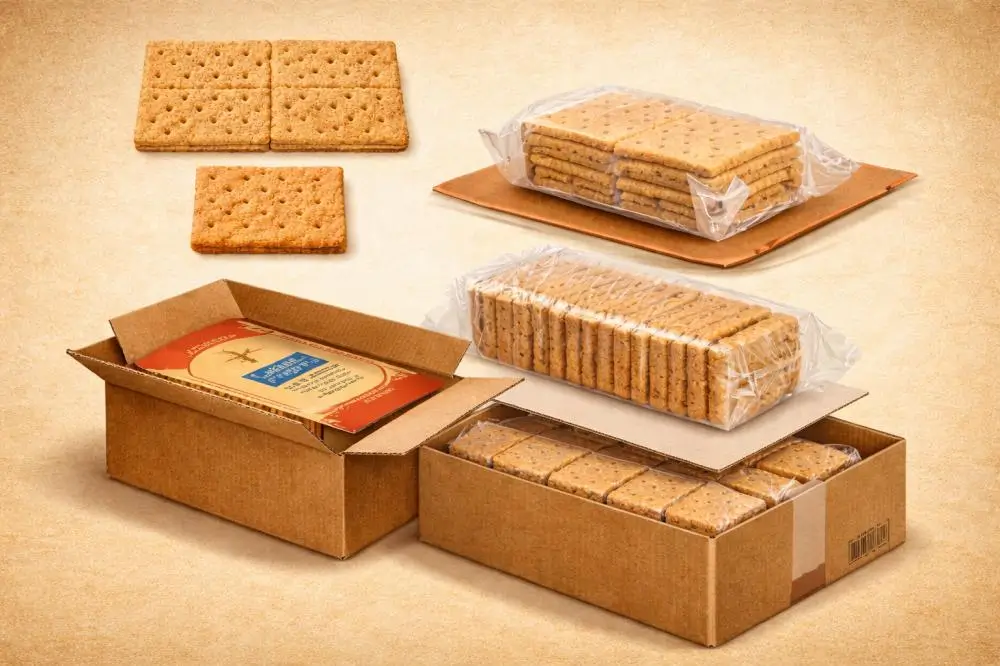
For many mainstream retail formats, a “standard box” is commonly described as 3 sleeves, with about 9–10 full sheets per sleeve, which is why you often see estimates around 27–30 full sheets per box. Treat this as a rule-of-thumb, not a specification—because brands, sizes, and definitions differ.
Best practice for accurate planning: use the nutrition label method below (it’s repeatable and defensible for procurement, QA, and co-man manufacturing).
Define “Cracker” First: Sheet vs Piece vs Serving
Most counting confusion is a definition problem:
- Full sheet (cracker sheet): the classic large rectangle panel (often perforated into smaller squares).
- Piece / square: smaller sections broken from a sheet (counts vary by brand and perforation pattern).
- Serving: a nutrition-label unit that ties directly to weight and typically references sheets/pieces.
Example label language commonly seen in the market: “8 crackers (1 serving = 2 full cracker sheets)”. That single line matters because it bridges pieces ↔ sheets ↔ weight, making your estimate audit-friendly.
The Reliable Method: Calculate Counts Using the Nutrition Label
Step 1: Capture two label fields
- Servings per container (often written as “about X servings”)
- Serving size (often defines sheets/pieces per serving)
For Honey Maid-type retail listings and label datasets, you commonly see:
- Serving size: 8 crackers (1 serving = 2 full cracker sheets)
- Servings per container varies by pack size (examples shown by retailers):
- About 13 servings (14.4 oz class)
- 18 servings (19.2 oz class)
- 27 servings (28.8 oz class)
Step 2: Convert servings into sheets (and optionally pieces)
If 1 serving = 2 full sheets, then:
- Estimated full sheets per box ≈ servings per container × 2
- Estimated crackers/pieces per box ≈ servings × 8 (only if that brand defines “cracker” as piece)
This method is more reliable than repeating a single number like “27” or “30,” because you can re-run it for any brand size and document your assumptions.
Typical Counts by Box Size
Because brands and formats vary, treat this as planning guidance rather than a guaranteed spec.
| Package Format | What You’ll Commonly See | What It Means for Planning |
|---|---|---|
| Standard retail box | “3 sleeves” + label-defined servings | Use label method for sheets; align carton ID to sleeve stack to reduce breakage |
| Family-size box | Higher “servings per container” | Often needs stronger paperboard + better headspace control to prevent crush |
| Single-serve packs | Pieces per pouch vary | Portioning is driven by pouch fill weight; carton is secondary packaging |
How Many Graham Crackers Are in a Sleeve?
Most consumer answers assume one sleeve contains about 9–10 full sheets. That’s directionally useful for recipe planning, but from a packaging perspective, the sleeve is doing the heavy lifting: it stabilizes stacks, reduces abrasion, and adds a moisture barrier layer when combined with the inner film system.
How Many Graham Crackers in a Cup?
You will see general guidance such as “1 full sheet ≈ 1/4 cup crumbs” and “4 full sheets ≈ 1 cup crumbs.” In practice, crumb volume changes with crush size and compaction, so we recommend weighing crumbs when consistency matters (commercial kitchens do this for repeatability).
Why Packaging Structure Matters
When brands ask “how many crackers in a box,” the operational reality is: you are balancing count accuracy with damage prevention. Crackers fail in two ways:
- Loss of crispness (moisture/oxygen exposure)
- Physical breakage (crush, vibration, corner impacts)
A typical graham cracker system is layered:
- Primary wrap/liner: barrier film and sealing to protect crispness
- Sleeve: stack stability and abrasion reduction
- Paperboard carton: branding + protection + retail facing
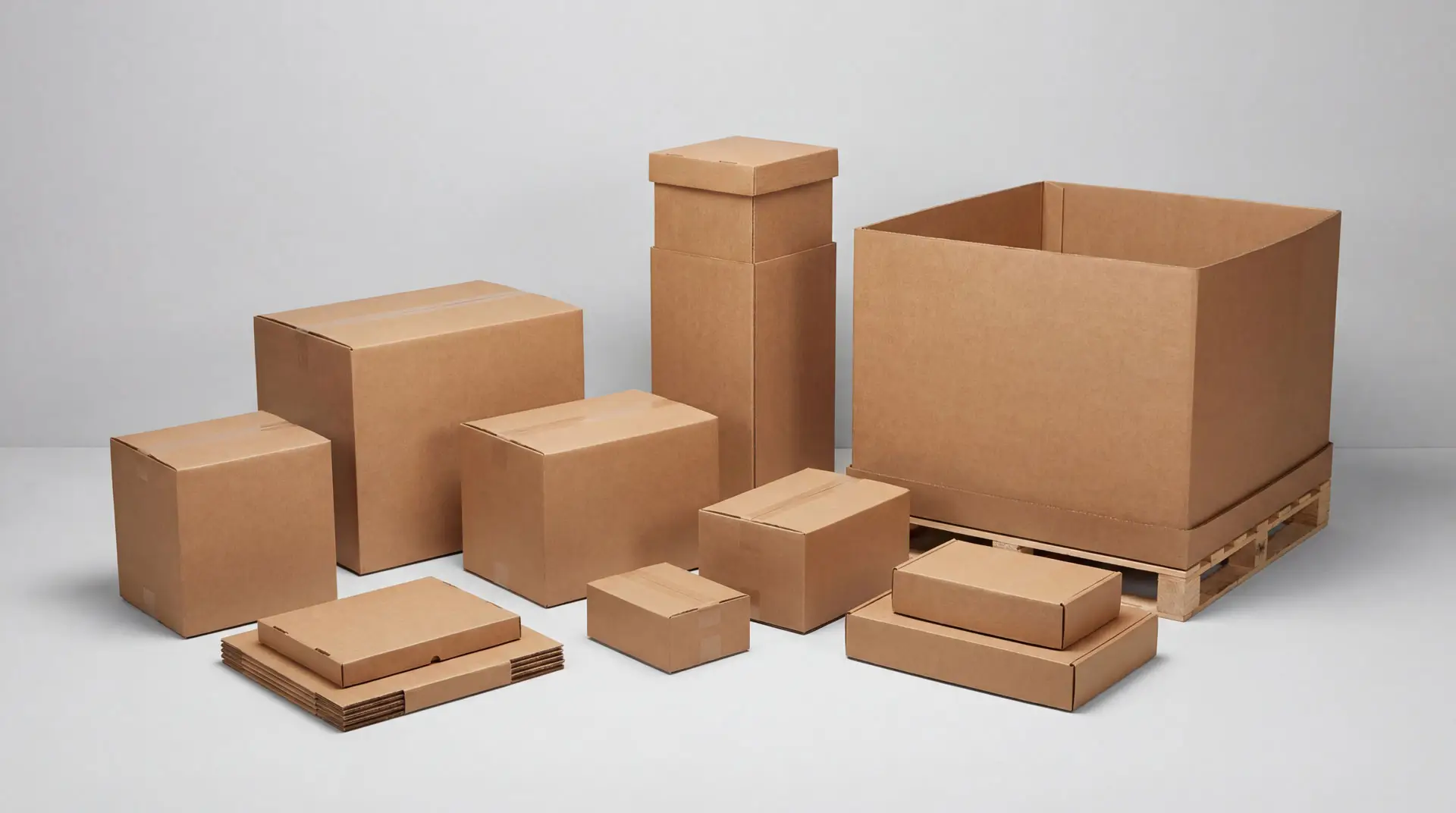
- Master case (corrugated): transport compression strength and pallet efficiency
This is why “air space” inside packaging is not always waste—it can be part of an impact-cushioning strategy, but only when headspace is controlled and the board grade is engineered for distribution.
Packaging Decision Table: What to Specify for Graham Cracker-Style Snacks
| Packaging Layer | Primary Goal | Practical Spec Focus | POZI Packaging Recommendation |
|---|---|---|---|
| Inner barrier system | Crispness | sealing integrity, moisture barrier | Validate storage + transit environment, then match barrier needs |
| Sleeve (inner pack) | Breakage control | stack height, snug fit | Design sleeve ID to reduce movement without crushing |
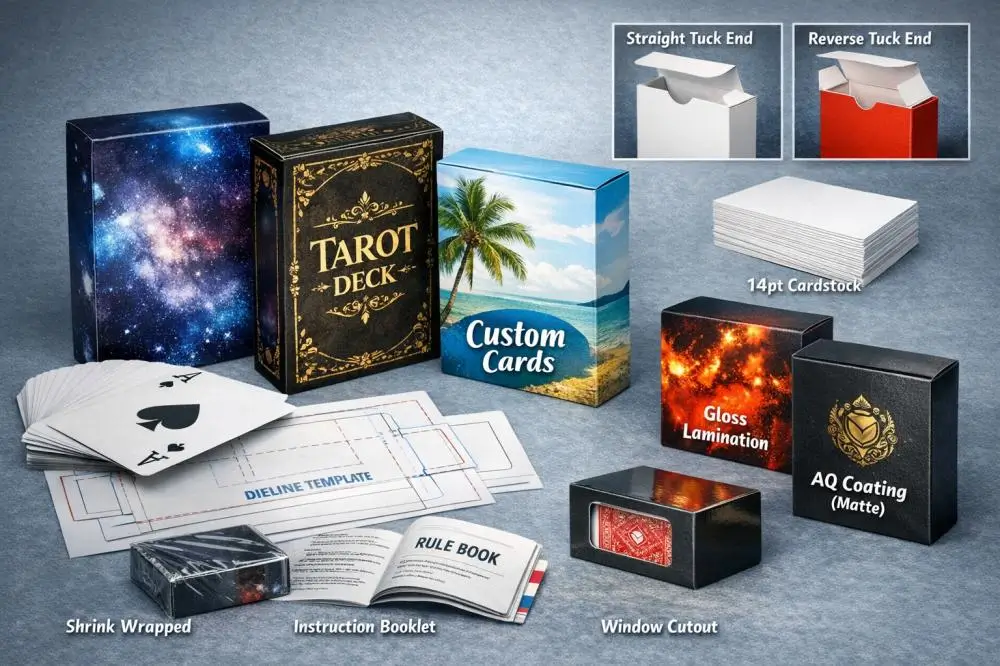
| Folding carton (retail box) | Brand + protection | paperboard caliper, closure design | Use custom folding carton structures that hold sleeve geometry stable |
| Shipping case | Transport safety | corrugated grade, stacking strength | Use custom shipping packaging / corrugated cases sized to prevent overhang |
Common Mistakes That Increase Breakage (And How to Avoid Them)
- Oversized cartons: sleeves rattle → corners chip → crumbs increase.
- Under-spec’d paperboard: carton panels bow under stack load → sleeve compression damage.
- No distribution logic: retail carton designed only for shelf, not for e-commerce drops.
- Weak dieline control: small dimensional drift changes headspace and sleeve fit.
If you are developing a new snack carton, your dieline is the control point. A clean dieline process reduces revisions, sampling time, and factory-side ambiguity.
FAQ: Graham Cracker Counts and Packaging
How many graham crackers are in a box?
Many standard retail references describe 3 sleeves and roughly 27–30 full sheets, but the accurate way is to use servings per container and serving size on the nutrition label to calculate.
What’s the difference between a “cracker,” a “sheet,” and a “piece”?
A sheet is the full panel; a piece is a perforated segment; “cracker” may refer to either depending on the label definition. Many labels clarify this by mapping pieces to sheets in the serving size line.
How many sleeves are in a typical box?
Many mainstream formats are commonly described as three sleeves, but it varies by brand and pack size. Always confirm with the package statement and label information.
How do I estimate the number of sheets in a box for production planning?
Use: (servings per container) × (sheets per serving). This scales across standard, family-size, and club packs because it is anchored to the declared serving definition.
Why do graham crackers come in sleeves inside a carton?
Sleeves stabilize the stacks, reduce abrasion, and support freshness by adding layers in the packaging system—reducing breakage and quality complaints in distribution.
Is “1 cup of crumbs” a fixed number of crackers?
No. Crumb volume changes with crush size and packing density. For consistency, commercial teams standardize by weight, not only cups.
Work With POZI Packaging: Build a Retail Carton That Controls Breakage and Looks Premium
If you are packaging graham cracker-style snacks, you typically need a carton that can do three things at once:
- protect sleeves from distribution damage,
- present cleanly on shelf,
- and run smoothly on packing lines.
At POZI Packaging, you can request a packaging recommendation based on your target count, sleeve geometry, and channel (retail vs e-commerce). We can support structure selection, dieline alignment, sampling, and scalable production.