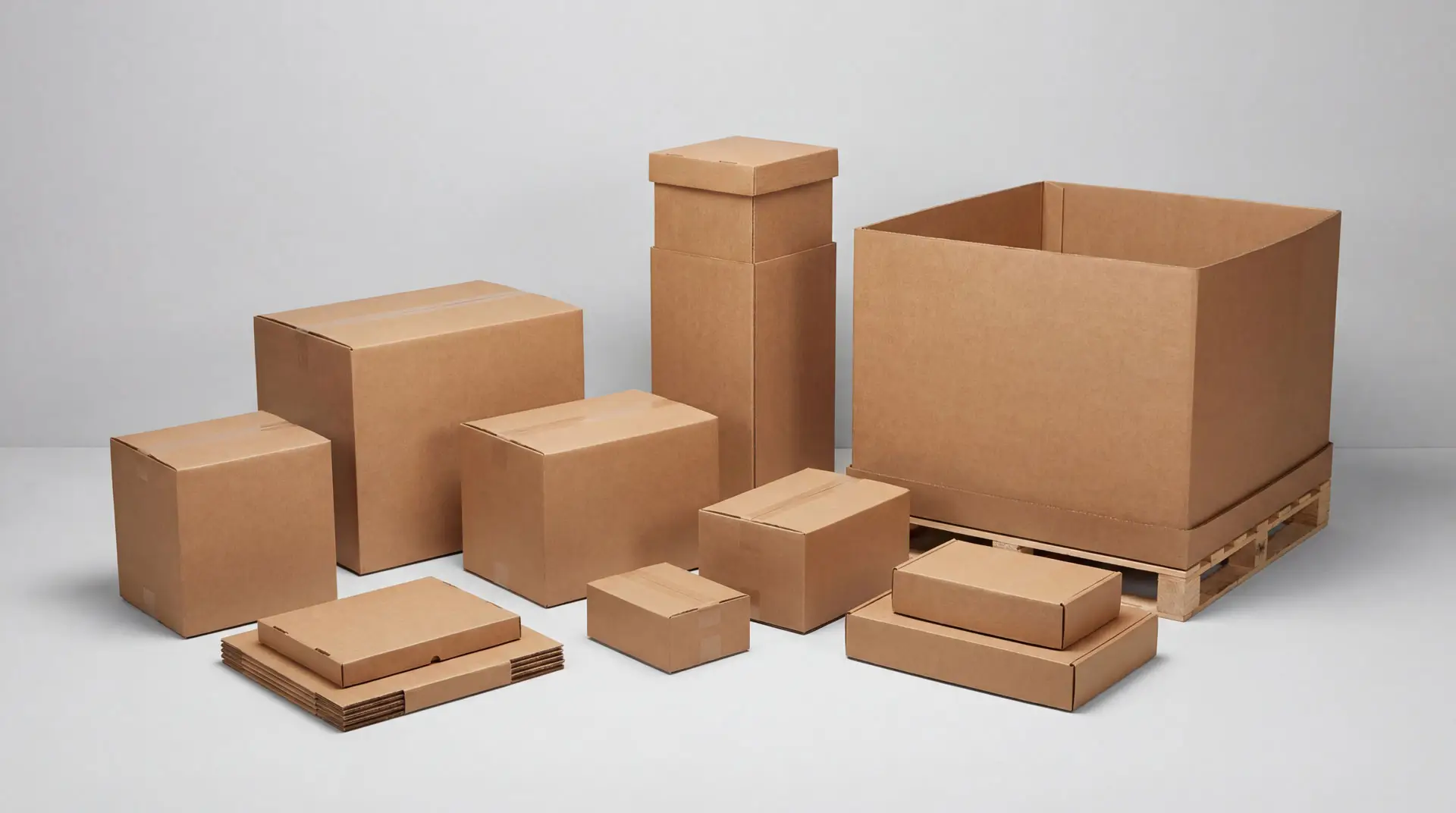
You’re not just buying a box—you’re specifying a shipping system. Strength is determined by the fibers, liners, flute profile, glue integrity, and how the box is handled through humidity, stacking, and transit shocks. This page gives you a practical, test-based way to choose the right spec for your products and shipping lanes.
Quick Answer — Cardboard Box Strength in One Minute
The short version:
-
Well-specified single-wall cartons typically carry 10–25 kg.
-
Double-wall cartons commonly support 30–80 kg, with better long-distance stacking.
-
Performance depends on paper grade (Kraft vs. recycled test liners), flute type (E/F/B/C/BC/AA), adhesion quality, box dimensions, humidity, stack height, and handling.
Design strength for your worst-case environment (humidity, time in stack, route vibration), then validate with BCT (Box Compression Test) or an ISTA-style transport test.
What Determines the Strength of a Shipping Box?
1) Paper Grades (Liners & Mediums)
-
Kraft liners (virgin or blend) deliver higher compression and tear resistance—ideal for heavy loads and export routes.
-
Test liners (recycled) are cost-efficient and sustainable; modern grades can still hit demanding ECT targets.
-
Fluting mediums (often semi-chemical) balance rigidity and cushioning. Consistency of fiber quality matters for repeatable compression.
2) Flute Type & Wall Structure
-
E/F flute: thin wall, better print and shelf aesthetics; suitable for light-duty shipping.
-
B/C flute: general shipping workhorses; C is thicker than B and offers more cushioning.
-
Double wall (e.g., BC) or triple wall (AA/AAA): for heavy industrial goods, tall pallet stacks, or long storage.
Rule of thumb: Taller flutes improve cushioning; higher flute count per 30 cm improves panel rigidity.
3) Construction & Adhesion Quality
-
Joint integrity (manufacturer’s joint) and glue penetration directly influence compression performance.
-
Box styles matter:
-
RSC (Regular Slotted Carton): efficient and cost-effective.
-
FOL (Full Overlap): overlapping major flaps add stacking and puncture resistance.
-
Telescoping or HSC/OPF (for specific load or machinery packaging) can improve edge support.
-
4) Moisture & Environmental Factors
-
Corrugated loses compression strength as relative humidity rises; extended exposure can reduce stacking strength by 30–60%.
-
For maritime and cold-chain, consider moisture-resistant liners, water-resistant adhesives, and barrier coatings.
5) Box Dimensions & Load Distribution
-
Larger panels deflect more under load.
-
Taller boxes need higher ECT to maintain the same stacking safety factor.
-
Keep flutes vertical in stacking orientation for maximum compression.
Key Strength Tests You Should Know
| Test | What It Measures | Typical Units | Why It Matters |
|---|---|---|---|
| ECT (Edge Crush Test) | Edgewise compression of combined board | kN/m or lb/in | Predicts stacking potential; used to specify board grade |
| BCT (Box Compression Test) | Whole-box compression to failure | N or kg | Real-world stacking under uniform load |
| Mullen (Burst Test) | Resistance to bursting/puncture | kPa or psi | Handling, rough contact, and drop resilience |
| Tensile/Puncture | Fiber tear and penetration resistance | N | Reduces tear-outs at flaps and corners |
| COBB | Water absorption rate | g/m² | Indicates moisture sensitivity for humid or cold-chain routes |
Practical guidance: Use ECT to shortlist a board; confirm with BCT at the box size and print/glue setup you will actually use.
Typical Load Capacities by Construction (Guideline)
| Box Type | Wall Structure | Common Flute | ECT Range | Approx. Static Load (kg) | Typical Applications |
|---|---|---|---|---|---|
| Light-duty mailer | Single wall | E/F | 23–32 | 5–15 | Apparel, accessories, light e-commerce |
| Standard shipper | Single wall | B/C | 32–44 | 15–25 | FMCG, general retail, shelf-ready packs |
| Heavy-duty carton | Double wall | BC | 44–56 | 30–50 | Food outers, small appliances, electronics |
| Export/industrial | Triple wall | AA/AAA | 56–90+ | 60–100+ | Machinery parts, bulk components |
| Rigid laminated | Paperboard wrap + corrugated core | Custom | Spec-driven | Design-based | Luxury/protective hybrids |
Notes: Values are indicative starting points. Always validate with BCT considering your dimensions, print coverage, adhesive system, and climate exposure.
Stacking Strength in Real Shipping Conditions
Static Compression
-
A common engineering approach uses BCT measured on your finished carton.
-
Apply a safety factor of ~5:1 for long storage or harsh conditions (strength decays over time).
Dynamic Loads (Drop, Vibration, Conveyor)
-
Real routes add shocks and cyclic loads.
-
Reinforce corners and add inserts/dividers for fragile or high-value items.
Palletization & Warehouse Practices
-
Keep cartons flush with pallets (no overhang).
-
Column stacking offers higher compression; interlocking improves stability but reduces stack strength.
-
Use pallet patterns and slip sheets to distribute loads and avoid point pressure.
Environmental Conditions & Durability
Temperature & Humidity
-
At high RH, adhesives soften and paper absorbs moisture, reducing stiffness.
-
Solutions: moisture-resistant liners, water-resistant adhesive, AQ/dispersion coatings, PE liners for extreme cases.
Long-Distance & Export Routes
-
Validate with ISTA 3A/6A-style testing (drop + vibration + compression).
-
For maritime, plan for container condensation and long dwell; consider double-wall and desiccants.
Cold Chain & Refrigeration
-
Select adhesives and liners proven for low-temperature cycles to prevent delamination or warp.
How to Choose the Right Strength Level (Step-by-Step)
-
Define product weight & fragility (including internal packaging).
-
Specify stack height & storage time (in days/weeks).
-
Map the route conditions (RH/temperature, export/maritime, handling equipment).
-
Set a target ECT range and shortlist flute/wall options.
-
Prototype & test (BCT on finished cartons; optional ISTA).
-
Iterate: adjust flute, liners, or add inserts to hit strength with best cost.
Tip: Many programs overspec wall thickness. A smarter combination—Kraft outer liner + recycled inner liner + right flute—often achieves the same BCT with lower material.
Cost vs. Strength Optimization
-
Diminishing returns: Jumping from single to double wall boosts strength but also increases fiber and freight.
-
Geometry first: Reducing panel spans (smaller boxes, better nesting) can lower the required ECT.
-
Targeted reinforcements: Corner posts, inner trays, or full-overlap flaps can outperform a raw wall upgrade.
-
Print coverage: Heavy ink or coatings can affect board moisture exchange; balance graphics with performance needs.
Sustainability and Strength — Finding the Balance
-
Recycled content slightly lowers raw compression but can still meet ECT/BCT targets with the right design.
-
Hybrid builds (Kraft outer + recycled inner) give a strong sustainability story and reliable performance.
-
FSC/PEFC chain-of-custody supports consistent mechanical quality across runs.
-
Light-weighting plus design-for-recycling (minimal mixed materials) reduces fiber and total carbon per shipped kg.
Case Scenarios (Practical Starting Specs)
| Product Type | Recommended Box | Key Specs | Notes |
|---|---|---|---|
| Cosmetics gift sets | Single-wall E or B | ≥32 ECT, litho-lam top liner | Use inserts; prioritize print and unboxing |
| Small electronics | Single-wall B or double-wall BC | ≥32–44 ECT | Corner cushioning; anti-static wraps |
| Pantry/FMCG outers | Double-wall BC | 44–56 ECT | Humidity-resistant liners for long warehouse storage |
| Export machinery parts | Triple-wall AA/AAA | 65–90+ ECT | Consider skids or reinforced bases |
| Wine/fragile glass | Single- or double-wall with dividers | ≥44 ECT (route-dependent) | Dividers carry much of the protection load |
Your final spec should be verified by BCT and, where relevant, route-specific testing.
FAQ
How much weight can a cardboard box hold?
As a planning range, single-wall cartons cover 10–25 kg and double-wall 30–80 kg. Confirm with BCT on your final size and print/glue setup.
Does humidity really weaken boxes?
Yes. Prolonged high RH can cut compression by 30–60%. Use moisture-resistant liners/adhesives, add barriers, or move to double-wall for maritime/cold-chain.
Which rating should I focus on—ECT or Mullen?
ECT correlates to stacking strength. Mullen focuses on burst/puncture. Choose based on your shipping risks; many e-commerce programs are ECT-driven.
Can lightweight boxes still be strong?
Yes. With a Kraft outer liner, correct flute, and good joint gluing, you can achieve target BCT while reducing fiber.
Do recycled liners always underperform?
Modern recycled liners can meet demanding ECT specs. Pair them with an outer Kraft liner and appropriate flute to balance cost, strength, and sustainability.
Get Engineering Support
Share your product weight, box size, stack height/time, and route conditions. Our packaging engineers will:
-
Define ECT/BCT targets for your scenario.
-
Recommend the flute and liner combination that meets strength at the lowest fiber.
-
Provide prototype samples and test guidance (BCT/ISTA).
-
Balance strength, cost, and sustainability—so you ship safely without overspec.
Request a material-matched shipping box specification today.