Custom White Reverse Tuck Folding Cartons
Custom White Reverse Tuck End (RTE) Folding Cartons for Retail-Ready Packaging
White reverse tuck folding cartons—commonly referred to as Reverse Tuck End (RTE) cartons—are one of the most widely specified folding carton structures for retail packaging. By combining a clean white board surface with a reverse tuck closure design, this carton style delivers excellent print clarity, efficient packing performance, and consistent shelf presentation, making it a reliable choice for cosmetics, pharmaceuticals, personal care products, gourmet food, and lightweight consumer goods.
As a professional folding carton manufacturer, we provide fully customized white reverse tuck folding cartons that align structure, material selection, and finishing quality with your product requirements and market positioning.
Customization Options for White Reverse Tuck Folding Cartons
| Customization Category | Available Options & Technical Details |
|---|---|
| Materials | ● SBS Paperboard (Solid Bleached Sulfate) ● Coated Ivory Board ● High-Gloss or Matte White Cardboard |
| Material Thickness | ● 250gsm – Lightweight retail use ● 300–350gsm – Standard for premium packaging ● Up to 450gsm for structural reinforcement |
| Dimensions | ● Fully customizable (L × W × H) based on your product ● Structural support for inserts and compartments available |
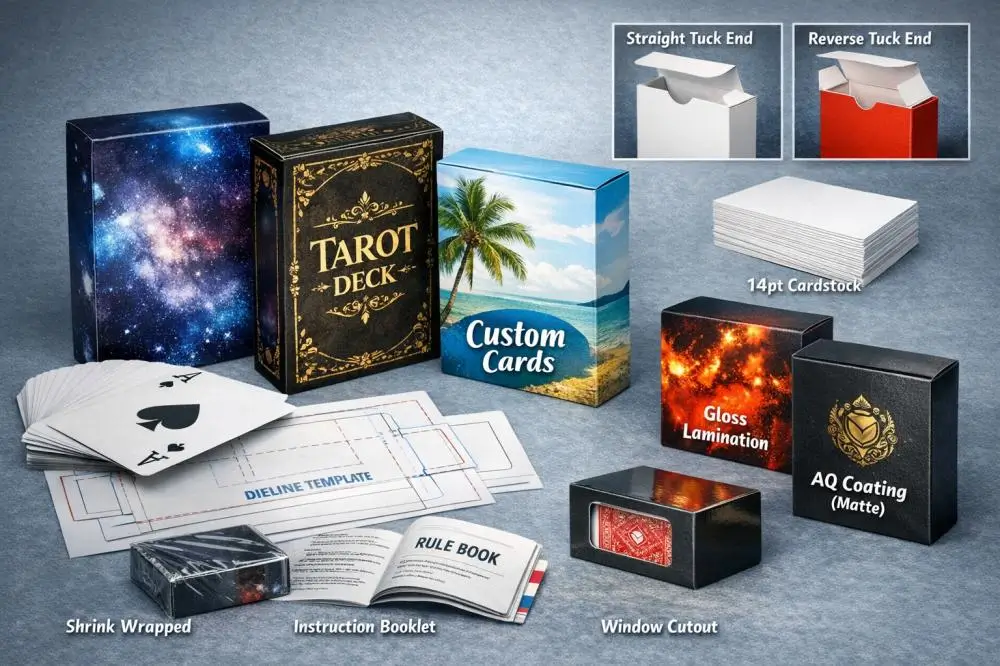
| Printing Methods | ● CMYK Offset Printing ● Pantone Matching (PMS) ● Digital Printing for small batches or personalized packaging |
| Surface Finishes | ● Gloss or Matte Lamination ● Soft-Touch Coating ● Foil Stamping (Gold, Silver, Holographic) ● Embossing / Spot UV |
| Structural Enhancements | ● Die-cut Windows ● Perforated Tear Lines ● Interior Printing ● Custom Inserts or Multi-panel Folding |
| Sustainable Options | ● FSC-certified paper ● Recyclable and biodegradable materials ● Soy-based and water-based ink systems |
| MOQ (Minimum Order) | ● 1000 cartons per custom design |
| Sampling & Turnaround | ● Sample in 5–7 working days ● Mass production in 10–15 working days post-approval |
| Shipping & Export Support | ● Global delivery via sea, air, or express ● Shipping terms: FOB / CIF / DDP ● Full export documents included |
| OEM / ODM Services | ● OEM: Print your branding on our structure ● ODM: We support full packaging development including dieline and layout design |
Every reverse tuck folding carton can be customized to meet your functional and branding requirements.
Core Specifications
- Fully customized dimensions
- Board grade and thickness selection
- Standard or reinforced tuck flaps
Printing Options
- CMYK process printing
- Pantone spot color matching
- Inside and outside printing
- Multi-language layouts for export markets
Surface Finishing
- Matte or glossy lamination
- Soft-touch coating
- Hot foil stamping
- Embossing and debossing
- Spot UV highlights
Functional Enhancements
- Window cut-outs with or without film
- Internal printing for instructions or branding
- Tamper-evident options such as tear strips, perforations, or seal-label areas
- Inserts or partitions for product stability
These options allow reverse tuck cartons to perform reliably while reinforcing brand identity.
What Is a White Reverse Tuck End (RTE) Folding Carton?
A white reverse tuck end folding carton is a paperboard carton where the top and bottom tuck flaps close in opposite directions. This reverse orientation affects how the carton opens, how graphics are oriented, and how the box behaves during filling and handling.
In practical terms, an RTE carton:
- Uses white paperboard (commonly SBS or ivory board) for superior print performance
- Features a reverse tuck closure that supports efficient folding and packing
- Maintains a compact, lightweight structure suitable for high-volume production
- Provides a balanced solution between protection, cost control, and visual quality
Reverse tuck cartons are commonly selected when brands need reliable retail cartons with consistent performance across multiple SKUs.
Why White Board Matters for Reverse Tuck Cartons
Material choice plays a critical role in the performance and appearance of white reverse tuck folding cartons.
Superior Print Clarity
White paperboard surfaces provide:
- High contrast for graphics and text
- Accurate color reproduction for CMYK and Pantone printing
- Clean background for regulatory information, barcodes, and batch codes
This makes white RTE cartons especially suitable for industries where information clarity and brand consistency are essential.
Consistent Folding and Creasing Performance
Quality white boards are engineered to:
- Fold cleanly along creases without cracking
- Maintain structural integrity at tuck flaps
- Support stable closure performance during repeated handling
These characteristics are essential for reverse tuck structures, where flap alignment directly affects carton usability.
Common Board Options
- SBS (Solid Bleached Sulfate): Premium appearance, excellent printability
- Ivory / Coated Board: Balanced cost and performance for large-volume programs
Board grade and thickness are selected based on product weight, carton size, and desired market positioning.
How the Reverse Tuck End Structure Works
The reverse tuck design is not arbitrary—it serves specific functional and operational purposes.
Opposite-Direction Tucking Logic
With the top and bottom tucks closing in opposite directions:
- Cartons can be erected efficiently on packing lines
- Opening behavior remains predictable for end users
- The structure supports consistent closure without complex locking mechanisms
Packing Line Compatibility
Reverse tuck cartons are widely used because they:
- Work well with semi-automatic and automatic carton erecting processes
- Maintain stable geometry during filling
- Reduce resistance when inserting lightweight products
For high-volume retail goods, this operational efficiency is a key advantage.
Retail Handling & User Experience
Reverse tuck cartons are easy to open and re-close, making them suitable for products that may be accessed multiple times, such as cosmetics or personal care items.
Reverse Tuck vs Straight Tuck vs Auto-Lock Bottom
Choosing the right folding carton structure depends on product weight, presentation needs, and packing conditions.
Reverse Tuck End (RTE)
- Top and bottom flaps close in opposite directions
- Lightweight and cost-efficient
- Ideal for cosmetics, pharma, and personal care
Straight Tuck End (STE)
- Both flaps close in the same direction
- Cleaner front-panel alignment for shelf presentation
- Often chosen for premium retail branding
Auto-Lock Bottom
- Reinforced bottom structure
- Suitable for heavier products
- Higher material usage and production complexity
White reverse tuck folding cartons are most appropriate when product weight is moderate, packing efficiency is important, and high-quality printing is required.
Industry Applications
White reverse tuck folding cartons are widely used across industries that value clean presentation and operational efficiency.
Cosmetics & Skincare
Ideal for creams, serums, and beauty products requiring premium print quality and regulatory labeling.
Pharmaceutical & Supplements
Supports clear information layout, batch coding, and consistent carton performance.
Personal Care Products
Used for soaps, grooming items, and hygiene products with frequent consumer handling.
Gourmet Food & Confectionery
Suitable for lightweight dry foods where presentation and brand clarity are important.
Consumer Electronics Accessories
Used for small electronics and accessories requiring organized, retail-ready packaging.
Quality & Consistency Controls
Quality control is essential for reverse tuck cartons, where small deviations can affect closure and appearance.
Our controls focus on:
- Color consistency: Pantone matching and batch-to-batch comparison
- Die-cut accuracy: Clean edges and precise crease placement
- Folding performance: Prevention of cracking at tuck flaps
- Closure reliability: Consistent tuck depth and flap alignment
- Surface durability: Resistance to scuffing and wear based on finish selection
These checks ensure reliable performance throughout storage, handling, and retail display.
Production Workflow & Delivery
Our production process is designed for accuracy and scalability.
- Specification confirmation and structural review
- Die-line development and sampling
- Mass production with in-process inspection
- Final quality check and packing
- Export-ready documentation and global delivery
This workflow supports stable lead times and consistent quality for repeat orders.
Frequently Asked Questions (FAQ)
What is a reverse tuck end folding carton used for?
Reverse tuck cartons are commonly used for lightweight retail products such as cosmetics, pharmaceuticals, and personal care items.
How is reverse tuck different from straight tuck?
Reverse tuck closes in opposite directions, while straight tuck closes in the same direction. The choice depends on branding layout, packing efficiency, and presentation needs.
Are reverse tuck cartons suitable for automatic packing lines?
Yes. Reverse tuck cartons are widely compatible with semi-automatic and automatic packing processes.
Can reverse tuck cartons be tamper-evident?
Yes. Tamper-evident options such as tear strips, perforations, or seal-label areas can be integrated.
What board is best for white reverse tuck cartons?
SBS and ivory board are commonly used due to their print quality and folding performance.
What is the minimum order quantity?
MOQ varies depending on size, board grade, printing, and finishing. Please contact us for a detailed quote.
Request a Custom White Reverse Tuck Folding Carton Quote
If you are sourcing white reverse tuck folding cartons for retail packaging, contact us with your product dimensions, target market, and finishing requirements. Our team will help you select the optimal structure, materials, and finishes to support your branding and supply chain goals.